Tesla update 2026.38.5.1 and third-party V2L adapters: why DC discharge stopped
What has been reported
This page reflects what we could confirm as of October 30, 2026. Software version 2026.38.5.1 was listed on October 13, 2026. On October 19, an owner on Tesla Motors Club (opens an external site) reported that a third-party V2L adapter on a Model 3, used near-daily for more than a year and a half, began stopping with the fault BMS_a076_SW_Dch_While_Charging. Not a Tesla App reported the story (opens an external site) on October 29.
- Scale: three owners in that thread report the failure. Only one names a car model, and none gives hardware details.
- Timing: one owner reports about 3 minutes at 3 kW. Two others report about 15 to 20 minutes, one of them regardless of load.
- Adapter makers: one owner says a test firmware from the maker of their adapter did not solve the problem. We have seen no statement from the maker itself.
- Tesla: we have found no statement from Tesla, and a published listing of the release notes (opens an external site) does not mention V2L, discharge or adapters.
Two different ways to take power from a Tesla
Coverage of this story tends to treat all V2L devices as one category. They are not, and the difference explains why a change can affect one type and not the other.
| Tesla adapter | Third-party discharge adapter | |
|---|---|---|
| What leaves the car | AC power | High-voltage DC from the pack |
| What makes the AC | The onboard power conversion system (PCS), part of the car | An inverter inside the adapter, outside the car |
| How the car treats it | The adapter tells the car to export AC, a function the car is designed to perform | A DC charging session, with the fast-charge contactors closed |
| Vehicles | Vehicles with the required power electronics | Vehicles that can run a CCS session; sellers state their own compatibility limits |
| Who answers for safety | The automaker designed and tested the complete path | The automaker can control only what is part of the car |
Every third-party adapter we have found in the US discharges over DC; we have not found one that uses the PCS. Tesla's Powershare home backup is a separate product again, with its own required equipment. One report on recent Shanghai-built cars (opens an external site) says earlier cars cannot be retrofitted with AC export because it requires specific bidirectional hardware. If so, this also weakens the suggestion that the change exists to steer those owners toward Tesla's adapter.
Our working theory of what changed
During DC fast charging, the fast-charge contactors connect the battery to the charge port. That session is designed to do one thing. A car does not need a dedicated sensor to know which way energy is moving: its battery management system (BMS) already has other ways to determine this, and the question is whether its software is written to check. In our view, most manufacturers do not build that logic for this scenario from day one.
The fault is not new. In a post dated January 31, 2025 (opens an external site), an owner who reports building their own DC charger described this same fault, its timing as somewhat random, and a threshold of 15 Ah, on both Tesla's own charging protocol and DIN 70121. Another owner in that thread described the alert as informational only. A community-compiled alert listing (opens an external site) describes it as the pack being discharged below a set threshold while charging.
The owner who first reported the update ran one test: after charging 0.25 kWh and discharging 0.39 kWh, a net 0.14 kWh, the car stopped the session. A load of 3 kW for 3 minutes is about 0.15 kWh. At an assumed 350 V, that is about 0.4 Ah, against the 15 Ah described in 2025. The recent update therefore appears to enforce the limit far more strictly. This is our working theory, based on forum reports and one unreplicated test, and Tesla has not confirmed it. The reports of 15 to 20 minutes regardless of load do not fit a simple energy limit, so more than one factor may be involved.
Why adapter firmware may not solve it
Adapter firmware controls what the adapter says to the car. If the car decides from what it measures at its own battery, a change in those messages does not change the measurement, and the adapter cannot show energy going in while taking it out. This is consistent with the report of a test firmware that did not help. One owner has since said they found a workaround, without details. We do not describe workarounds here, and we would not rely on one for equipment that has to work in an outage.
CCS also provides a stronger tool, although nothing we have seen suggests it is in use here. As our guide to the technology explains, ISO 15118-2 uses TLS only for Plug and Charge, while ISO 15118-20 requires TLS 1.3 with mutual authentication. A car that required a certificate it trusts could refuse an unrecognized device at the start of a session, and an adapter maker could not resolve that with firmware unless it held a certificate the car accepts. The limit is compatibility, because many public chargers still implement only ISO 15118-2 (opens an external site). The reported adapters still discharge for minutes before stopping, which points to a check on energy rather than on identity.
The safety issues
Vehicle engineers spend significant effort on functional safety, but they can control only what is part of the car. A discharge device that is not approved by the manufacturer operates outside the conditions that the car's safety design assumes.
- Exposed high-voltage DC: the pack voltage leaves the car through the charge port into a consumer device, in a driveway, handled by people without high-voltage training. Discharge cables are typically thin, because they carry only the small current of the adapter's inverter, and a damaged cable can produce a dangerous, potentially lethal arc flash. A higher pack voltage increases the hazard.
- Contactors opening under load: the January 2025 post reports that when this fault occurs, the DC fast-charge contactors open under load. A different owner describes the same event as a hot-open and a repeated clunk. Contactors are heavy relays, and interrupting DC current wears them and can lead to welding. A fault that arrives sooner could make this more frequent.
- Insulation monitoring: during DC charging, the charging station typically monitors insulation for both station and car (opens an external site), according to one equipment maker. A discharge device takes on that function, and we have seen no independent test of how well any of them perform it.
- Startup: precharge is needed to prevent a damaging inrush of current when the contactors close onto the device's capacitors.
- AC output: grounding and fault protection depend on the adapter. Connecting one to a home panel without a listed transfer switch can energize utility lines and endanger line workers.
- Listing: we have seen seller claims of certification but have not verified a listing for these adapters. Check the listing mark and file number yourself.
Tesla's US warranty (opens an external site), effective September 1, 2026, excludes using the vehicle as a stationary power source outside supported Powershare setups. Before relying on any device, read the wording for your own car.
From our projects
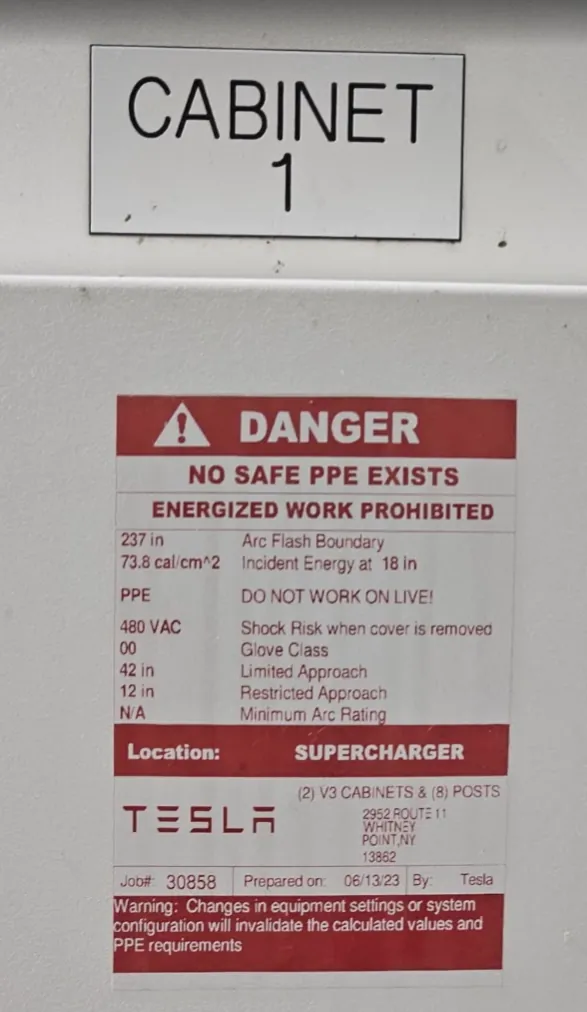
Exporting the high-voltage DC link is very dangerous. When you're talking about a 900 V architecture like the Cybertruck, no PPE exists to protect a person against that kind of DC voltage. That's why a non-OEM discharge device worries us: it can compromise carefully designed safeguards by tricking the car. A Supercharger actively charging a car can reach up to 900 V on the DC side, and a third-party DC adapter brings pack voltage out through the charge port on a cable that's typically very thin, since it only has to carry a small current. If someone trips on that cable, a lethal arc flash can occur.
We don't say this from the sidelines. As our EV battery guide describes, we ran our own engineering test through a car's DC port, with the car outdoors and away from the house. That's how we know what it takes. It's an engineering test, not something to sell or to try at home.
Where the current coverage needs care
The Not a Tesla App report accurately states that the cause is unclear and that the evidence comes from owners. We would add the following points to it.
- First affected version: the first owner moved from 2026.26.6.5 directly to 2026.38.5.1, so the change could have arrived in any build in between. The owner warned of “potentially other nearby versions”; we have seen no test of later builds.
- New check or stricter check: the report describes forum members suspecting a new check. The 2025 posts indicate that the fault and a threshold already existed.
- Connector: the report refers to the CCS port. North American Teslas have a NACS inlet, and CCS here describes the communication the car uses. A physical CCS2 port is found on European cars.
- Entry-level trims: the report says V2L has expanded to entry-level trims. The article it links concerns Shanghai-built cars and treats the variants as unconfirmed.
- Motive: the report notes the timing of Tesla's own adapter. That adapter launched in late 2025, and the first owner's use, near-daily cycling from 97 to 10 percent, is another plausible reason for an automaker to act. We do not know Tesla's reason.
- Security: the report suggests that unauthorized devices are a security risk. It gives no source, and every public DC charger already communicates with the car over the same interface.
What to do if you rely on V2L or want home backup
- For appliances and camping: check whether your car supports Tesla's own adapter. Its power is lower than the third-party devices', but it is the path the car was designed to provide.
- For home backup: use automaker-approved V2H equipment with a proper transfer setup, installed under an electrical permit.
- For solar storage: a listed battery on a hybrid inverter does not depend on a vehicle's software.
- For a renovation: prepare the panel and conduit now so that bidirectional equipment can be added once your car supports it.
Whether to delay a software update is a decision for each owner, but updates can also carry safety and other fixes, so we do not recommend skipping them to keep an accessory working.
In short
Owners report that third-party V2L adapters now cut out within minutes after a recent Tesla update, with a fault for discharging during charging. Every third-party adapter we have found in the US discharges over DC through the charge port, while Tesla's own adapter is AC, produced by the car's onboard PCS, so the two are different power paths. Our working theory is that the car always had ways to determine the direction of energy flow and that the update enforces an existing limit far more strictly. Tesla has not confirmed this. For dependable home backup, we recommend equipment the automaker approves.
Frequently asked questions
Did Tesla block third-party V2L adapters on purpose?
It is not known. Tesla has made no statement that we have found. The reports show a fault that existed before this update and appears to be enforced more strictly now, which fits a deliberate change, a side effect of other work, or both.
Does the update affect Tesla's own V2L adapter?
We have seen no report that it does. Tesla's adapter uses the car's onboard PCS to export AC, while the affected third-party adapters discharge DC through a charging session. The two are different power paths.
Can adapter makers fix this with a firmware update?
It may be difficult. Firmware changes what the adapter tells the car, but not what the car measures at its own battery. One reported test firmware did not help. One owner says they have found a workaround, but has given no details.
Can I use a third-party V2L adapter to power my house?
We do not recommend it. Home backup needs a listed transfer setup that isolates the house from the grid, a permit and an inspection. We plan and install the electrical side for automaker-approved equipment.
Sources
6 sources
- Tesla V2L AC inverter users: do not install 2026.38.5.1 (opens an external site)Tesla Motors Club
- North America's First V2L Discharge Device (thread, page 14) (opens an external site)Tesla Motors Club
- Tesla Breaks Compatibility With Third-Party V2L Devices (opens an external site)Not a Tesla App
- BMS_a076_SW_Dch_While_Charging (opens an external site)Tessie
- Implementation guide for TLS with ISO 15118 (opens an external site)CharIN
- New Vehicle Limited Warranty (opens an external site)Tesla
This guide reflects our experience and our interpretation of the rules as of the date it was published or last updated. Regulations, codes, incentives and the way agencies enforce them change often, and our interpretation may be incomplete or wrong. It is general information, not legal, engineering, tax or financial advice. Consult the relevant agency and a licensed professional before you plan, purchase or begin any work. Reading this guide does not make you our client and does not create any contractor, consulting or advisory relationship. Outstanding Construction Inc is not liable for any loss arising from the use of or reliance on this content, and is responsible only for work performed under a written contract signed with us.